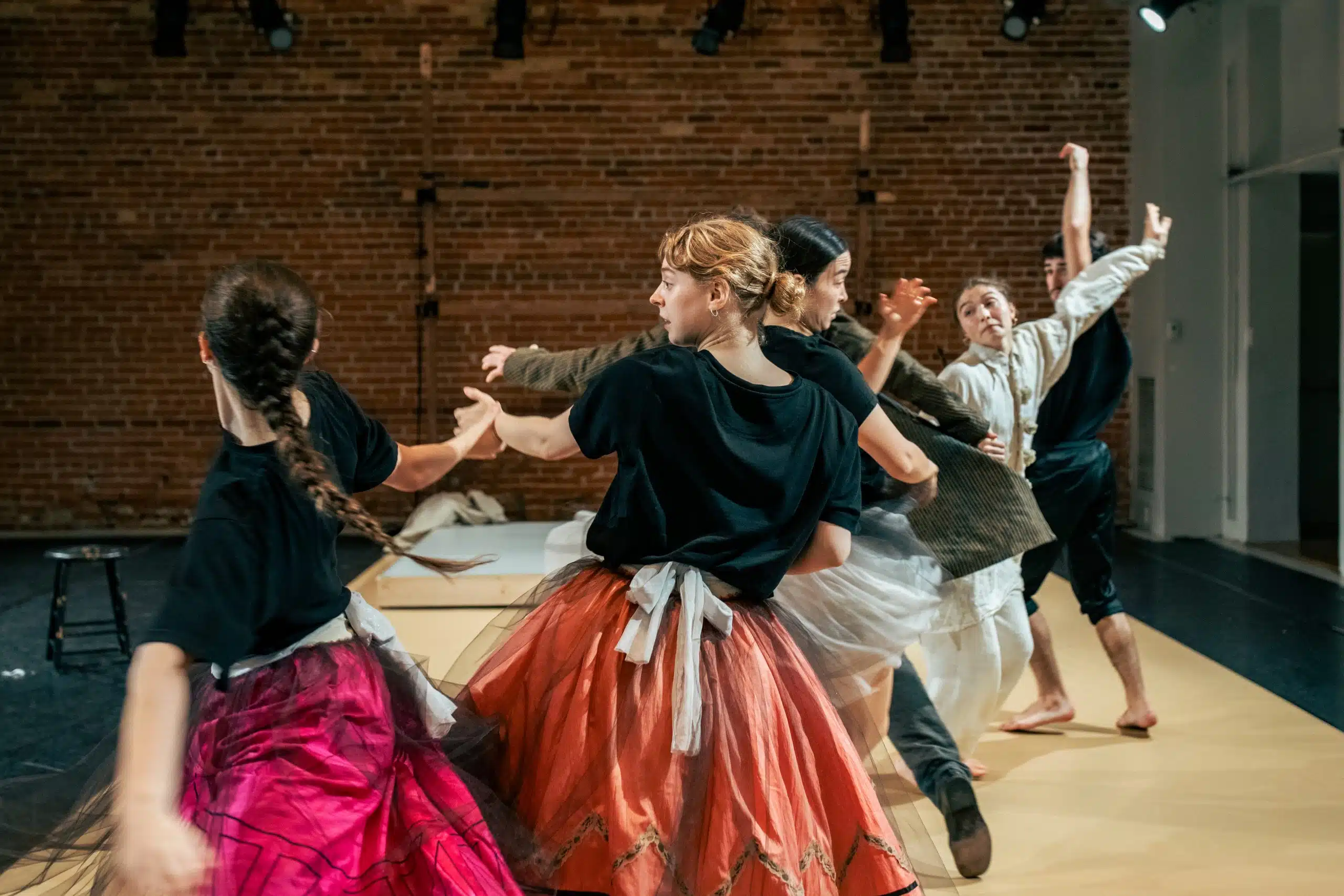
From Creator to Creation: The Dramaturg’s Reflections on the Development of “Contes pour la fin du temps”
Written by Maria Schultz, Dramaturgical Intern at Citadel + Compagnie in the fall of 2024, Dramaturg for Contes pour la fin du temps by Laurence Lemieux for Citadel + Compagnie / Echo Chamber.
Storytelling as a process
On the first day I joined the process for Contes pour la fin du temps, Laurence showed me her old, well-loved puppet theatre from when she was a child. She told me how this idea of making up and telling stories essentially planted a seed of her desire to become an artist. It was clear to me that she was inspired by the idea of the puppet theatre and wished to tell a narrative story with this piece. This marked the beginning of a creative process that involved continuously weaving symbols, meanings, characters, and dynamics in time and space. Early on, we started developing a libretto – a script – which served as a framework that should allow both the performers and the audience to delve deeper into the world of the piece, encouraging smaller storylines to emerge within.
Libretto
Contes pour la fin du temps follows The Ringmaster, a driven creator whose relentless desire to craft and tell stories seems fueled by both boundless imagination and a need to escape crisis. Immersed in a constant flow of creativity, he animates a world of puppets, each with its own narrative in a larger tale: Three Dolls – mechanical, simple, and engaged individuals operating as a unit; and Petrushka and Petrushkina – two siblings bound by deep angst, a desire to trust, and shared loyalty.
As the tale progresses, The Ringmaster delights in his creation, but his excitement gradually turns to unease when uninvited puppets enter and disrupt his carefully controlled tale. First, The Princess – a proud and enigmatic figure containing both power and mystery. Then, Pierrot – the archetypal white clown of theater lore, embodying the alienated observer – a tortured artist grappling with existential suffering, desire, and heartsickness. And ultimately, The Angel, a final warning sign and tender support.
As his creation gradually gains autonomy, The Ringmaster finds his authority and authorship slipping away. The work culminates in his realization that he is both the creator and inhabitant of a tale for the end of time, leaving him isolated to confront and surrender to his own reality.
Creating response and the nature of the creative process
Laurence approached the choreographic task of this commission by creating a response to the existing music, Quatuor pour la fin du temps by Olivier Messiaen, which was composed in a prison camp during World War II. The background story of the music was ever-present in the process, though it never dictated the material in an autobiographical way. Instead, it was a constant reminder of the core theme of Laurence’s choreographic response: the act and nature of artistic creation.
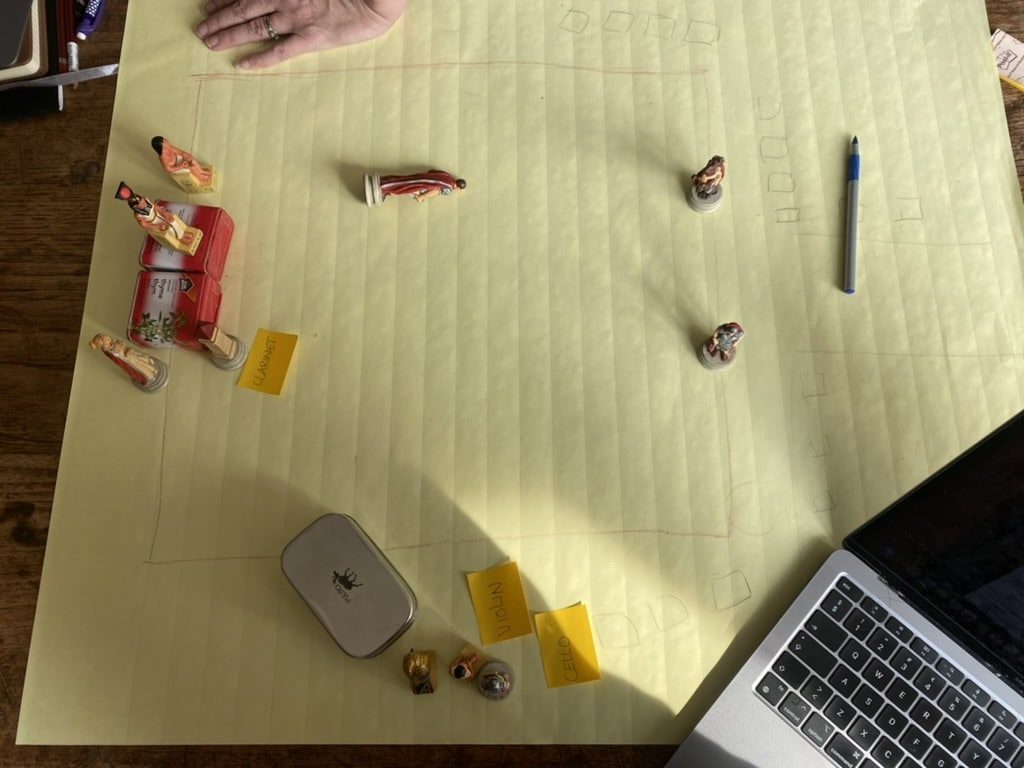
As the creative process progressed, the team began discussing sets and costumes: “Where can we find a wooden box? Do we have a jacket that looks like this? Would this vinyl floor we already have work for the piece?” We realized how much this process resembled what we were trying to convey in the piece itself. With Laurence as The Ringmaster, the team came together to assemble the elements – set, costumes, lights, movements, dramaturgy – embracing upcycling and the ever-dynamic character of a creative process as a main concept for both the production and piece.
Developing Contes pour la fin du temps was a journey into the heart of the act of creation itself – scripting, building, conceptualizing, brainstorming, testing, reflecting, discussing, loving and hating, revisiting, rebuilding, and reframing, all leading to its resolution on opening night.
Thematic resonance
The narrative’s heart lies in the character of The Ringmaster, whose relentless drive to create mirrors the potential urgency and turmoil of artistry. The dramaturgical challenge was to balance this story, embodied in a character, with universal questions as: What is the relationship between art and the artist? What are the boundaries between imagination and reality? What happens when we lose control of our creations? In retrospect, it was questions like these that drove our explorations and informed discussions on everything from movement vocabulary to visual storytelling.

World-building through puppetry
By the time I joined the process, Laurence had already developed a catalogue of characters inspired by the puppet theatre – figures that carried specific energies. Collaborating with Laurence, we aimed to highlight the function and interplay of these characters. For example, The Three Dolls’ mechanical unity contrasting sharply with the raw emotion of Petrushka and Petrushkina. The Princess and Pierrot, as uninvited disruptors, bringing complexity and ambiguity: The Princess with her allure and power, and Pierrot, whose role in theatre history grounds him as a figure of existential struggle and longing. Together, they become foils to the controlled world The Ringmaster has built – and perhaps a reflection of the world he is trying to escape. And ultimately, The Angel, a stable symbolic figure whose meaning is however always shaped by the context in which it appears.

Theatricality and existentialism
From a dramaturgical standpoint, the use of puppetry served as an elegant metaphor for autonomy and dependence. Moreover, the inclusion of the archetypal Pierrot anchors the piece in theatrical tradition, evoking the melancholia of commedia dell’arte while creating space for a contemporary audience to reflect on alienation. The character of The Ringmaster posed a fascinating dramaturgical puzzle with both his immense imagination and prominent limitations. His journey needed to be clear without being reductive. As his delight in creation leads to unease, the narrative mirrors the experience of any creator wrestling with losing ownership of their work and creative energy.
The process also included many discussions about the theatricality of the space itself. Laurence had the idea of using a platform as a stage for the puppets. Questions like “But why? Do we need it? What are we trying to say with it?” often came up in conversations. Ultimately, she decided to keep the platform, which became an effective tool to enhance moments of heightened theatricality. This allowed the audience to witness plays within a play, embracing theatricality as a primary method to tell this tale.

In retrospect
For me, Contes pour la fin du temps is a meditation on the act and nature of storytelling, creation, and the artist’s paradoxical role as both master and servant of their artistry. It is a tale for our times – and for all times throughout history – where imagination offers both escape and confrontation. It was a privilege to help weave these threads together, creating a world that is as unsettling as it is beautiful.